Trend Report: Safeguarding Rattan and Bamboo Storage Products During Extended 6-Month Warehousing
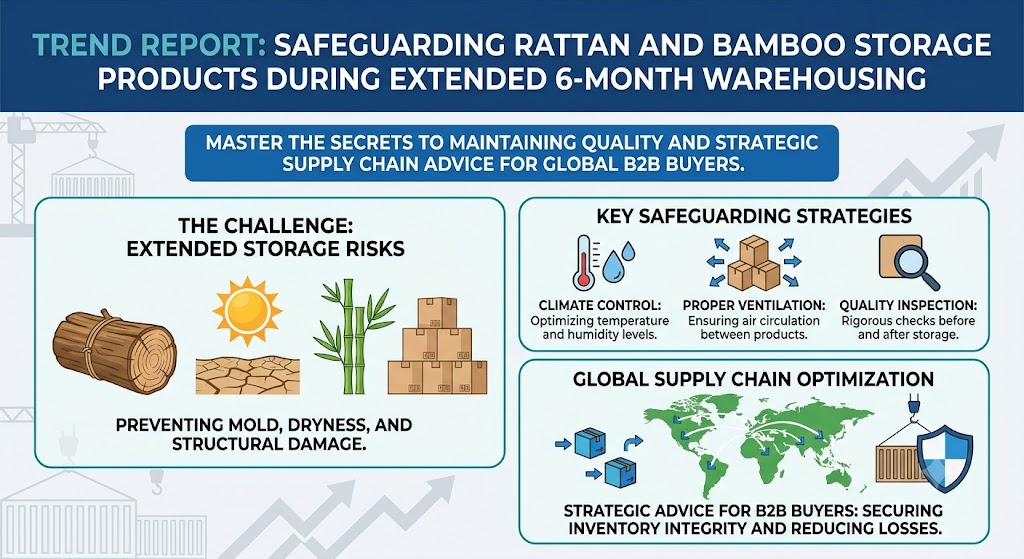
KEY TAKEAWAYS:
- Maintaining relative humidity between 50% and 65% prevents mold growth and structural brittleness in rattan and bamboo storage goods during extended storage.
- Standardized palletization and elevated racking eliminate ground moisture absorption and physical deformation during 6-month warehousing cycles.
- Integrating certified kiln-drying techniques with eco-friendly protective coatings ensures long-term product integrity and compliance with BSCI and ISO 9001:2015 standards.
EXECUTIVE SUMMARY: PRESERVING RATTAN & BAMBOO QUALITY IN LONG-TERM STORAGE
As global retail supply chains adapt to fluctuating lead times and buffer inventory strategies, maintaining product quality over extended warehousing periods has become a critical operational priority. Natural fiber goods—specifically rattan, bamboo, seagrass, and water hyacinth storage baskets and furniture—are highly sensitive to environmental variables during 6-month storage cycles.
This Trend Report synthesizes industry insights for global B2B buyers, sourcing managers, and interior designers. By evaluating material behavior, humidity dynamics, and advanced preservation techniques, this report outlines actionable practices to protect inventory value from factory floor to retail shelf.
CURRENT LANDSCAPE: WAREHOUSING VULNERABILITIES IN NATURAL FIBER PRODUCTS
Natural materials such as rattan and bamboo possess hygroscopic properties, meaning they continually absorb and release moisture based on ambient relative humidity (RH). When stored in non-climate-controlled warehouses for up to six months, products face two primary degradation threats:
- Moisture Accumulation & Mold Growth: Ambient RH exceeding 70% creates an environment where mold spores thrive, jeopardizing aesthetics and safety standards.
- Desiccation & Structural Brittleness: Conversely, RH levels below 45% dry out natural fibers, causing warp, joint looseness, and cracking under stacking load.
Global brands operating under international compliance frameworks (such as BSCI, SMETA, and ISO 9001:2015) require standardized storage protocols to mitigate write-offs and preserve margin integrity.
KEY TRENDS IN CLIMATE CONTROL, MATERIAL SCIENCE, AND STORAGE PROTOCOLS
1. Precision Kiln-Drying and Moisture Management
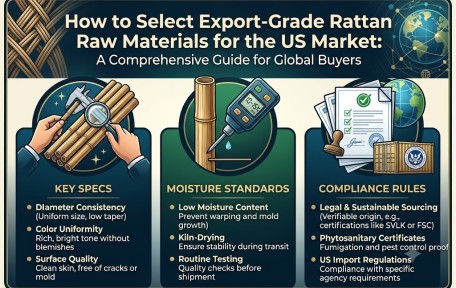
Leading manufacturers now enforce strict pre-shipment moisture content (MC) thresholds between 10% and 14%. Reaching this baseline through controlled kiln-drying prevents internal moisture migration while products reside in sealed cartons for extended months.
2. Eco-Friendly Bio-Protective Finishes
The industry is transitioning away from heavy chemical varnishes toward water-based, low-VOC protective lacquers and eco-friendly anti-fungal treatments. These solutions shield natural rattan, bamboo, and paper cord weaves against ambient moisture without compromising organic appeal or European chemical safety standards.
3. Engineered Packaging and Micro-Climate Solutions
Advanced master carton packaging incorporates high-absorption desiccant packs, micro-perforated polybags, and structural corrugated inner dividers. This creates a balanced micro-climate inside the master carton, buffering the products against external temperature swings during transit and long-term storage.
FUTURE OUTLOOK: SMART LOGISTICS AND SUSTAINABLE MATERIALS INTEGRATION
Over the next 24 to 36 months, warehousing strategy for natural home decor and storage solutions will increasingly merge with smart supply chain tracking. Innovations on the horizon include:
- IoT Environmental Monitoring: Real-time warehouse sensors tracking temperature and RH anomalies directly linked to inventory management platforms.
- Hybrid Material Weaves: Combining natural rattan and bamboo with durable polyester/cotton ropes or recycled plastic (PE/PP) resins to enhance resilience while preserving organic aesthetics.
- Circular Packaging Standards: Fully biodegradable moisture-barrier films replacing conventional plastics in wholesale shipments.
STRATEGIC RECOMMENDATIONS FOR B2B IMPORTERS AND SOURCING MANAGERS
To guarantee that rattan and bamboo storage hampers, units, and accessories retain peak condition across a 6-month warehousing window, Phu Minh Co., Ltd. recommends the following execution protocol:
- Enforce Off-Ground Elevated Racking: Store master cartons on pallets positioned at least 15 cm above ground levels to prevent cold floor moisture transfer.
- Maintain Optimal Climate Standards: Regulate warehouse conditions between 50% and 65% RH at 18°C to 25°C. Ensure consistent airflow across storage racks.
- Audit Supplier Quality Certifications: Partner with manufacturers holding audited facility compliance standards (SCAN, WCA, BSCI) to ensure consistent moisture control protocols at the origin factory.
FAQ SECTION:
1- What is the optimal humidity range for storing rattan and bamboo products in a warehouse?
The ideal ambient relative humidity (RH) for storing natural fiber storage goods is between 50% and 65% at temperatures between 18°C and 25°C.
2- How can buyers prevent mold growth during 6 months of warehousing?
Ensure products undergo professional kiln-drying to 10-14% moisture content before shipping, utilize adequate desiccant bags in master cartons, and maintain elevated, palletized storage with good air circulation.
3- Why is off-ground palletization essential for natural fiber goods?
Palletization lifts cartons off concrete floors, preventing humidity absorption from subterranean cold spots and reducing the risk of bottom-box crushing.
RELAVANT ARTICLES