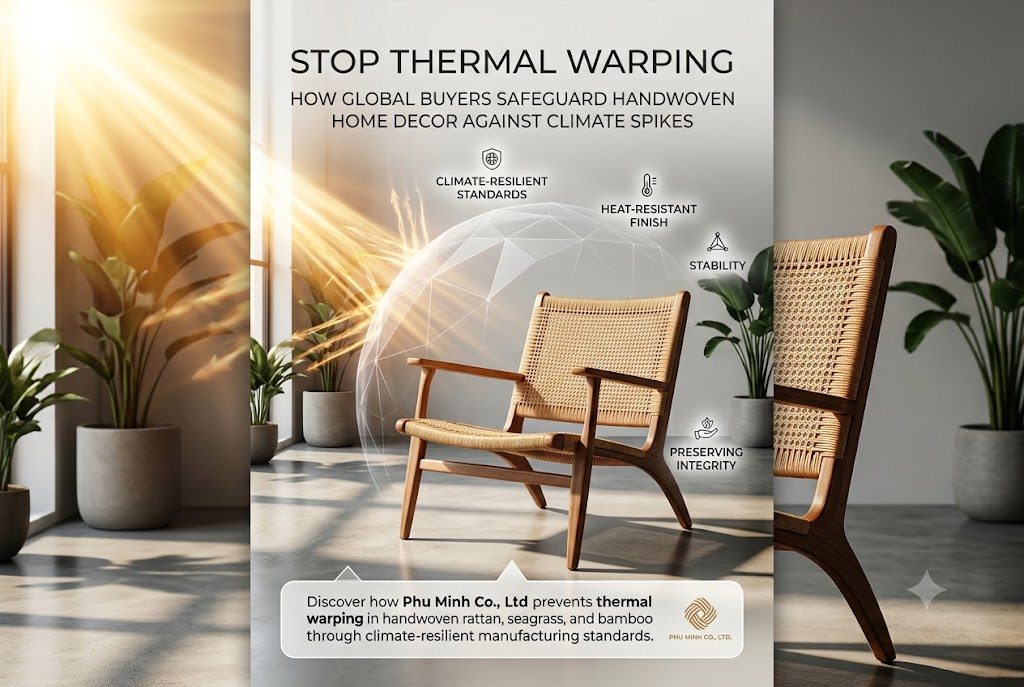
Stop Thermal Warping: How Global Buyers Safeguard Handwoven Home Decor Against Climate Spikes
KEY TAKEAWAYS:
- Thermal warping in handwoven decor is driven by rapid moisture loss and differential expansion between natural fibers and structural frames.
- Maintaining an Equilibrium Moisture Content (EMC) of 8% to 12% through precision kiln-drying prevents deformation during transit across volatile climate zones.
- Hybrid structural designs combining natural fibers (rattan, seagrass, water hyacinth) with engineered acacia frames or metal skeletons eliminate bowing under thermal stress.
- Phu Minh Co., Ltd. implements ISO 9001:2015 and BSCI-certified quality controls to deliver climate-resilient handcrafted storage and decor solutions globally.
THE SILENT PROFIT KILLER: WHEN THERMAL SHOCK WARPS HANDWOVEN SHIPMENTS
Picture this scenario: your shipment of premium handwoven laundry hampers and storage baskets arrives at a North American or European distribution center during mid-winter. Upon opening the containers, your quality assurance team discovers bowed frames, twisted weaves, and unstable bases. Thermal shock—caused by abrupt shifts from hot, humid equatorial factories to freezing transit conditions and warm indoor HVAC systems—has rendered the inventory unmarketable.
For global procurement managers and interior design directors, thermal warping is more than an aesthetic flaw; it represents compromised structural integrity, customer returns, damaged retail reputation, and squandered profit margins. In an era where commercial buyers demand zero-defect reliability, understanding and mitigating thermal deformation in handcrafted natural goods is a non-negotiable prerequisite for supply chain stability.
THE SCIENCE OF DEFORMATION: WHY NATURAL FIBERS REACT TO SUDDEN CLIMATE SHIFTS
To prevent thermal warping, procurement teams must first understand the bio-mechanical behavior of organic weaving materials like rattan, bamboo, water hyacinth, seagrass, and paper cords. These natural materials are intrinsically hygroscopic—they continuously absorb and discharge ambient moisture to achieve equilibrium with their surrounding atmosphere.
1. Differential Expansion and Moisture Imbalance
When exposed to sudden temperature spikes or extreme cold, the moisture trapped within organic plant cells rapidly evaporates or redistributes. Because different parts of a woven piece (such as a thick acacia wood rim versus a delicate seagrass weave) shrink at varying rates, internal tension builds up. This differential contraction causes the product to twist, bow, or cup.
2. Structural Frame Disconnect
Storage furniture and laundry hampers rely on rigid under-structures. When natural fibers expand or contract faster than the underlying pine, acacia, or iron frame, the material pulls away from its anchor points, resulting in permanent dimensional distortion.
ENGINEERING RESILIENCE: HOW PHU MINH GUARANTEES ZERO-WARP HANDWOVEN PRODUCTS
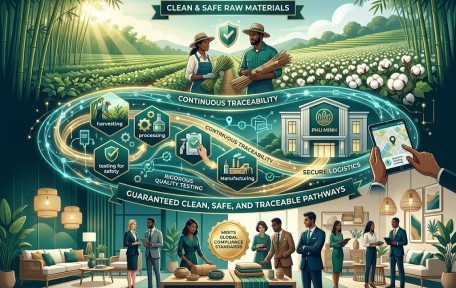
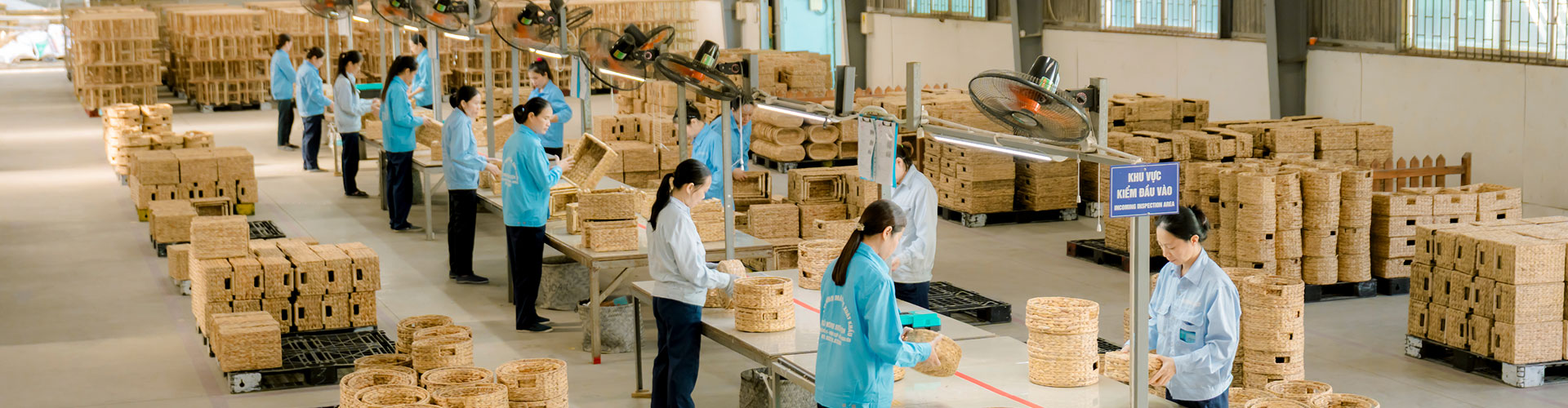
At Phu Minh Co., Ltd., we bridge the gap between traditional Vietnamese artisanal craftsmanship and rigorous international engineering standards. We eliminate thermal vulnerability through an integrated, multi-stage quality control process audited under ISO 9001:2015, BSCI, SMETA, SCAN, and WCA guidelines.
Precision Kiln-Drying & Moisture Content Management
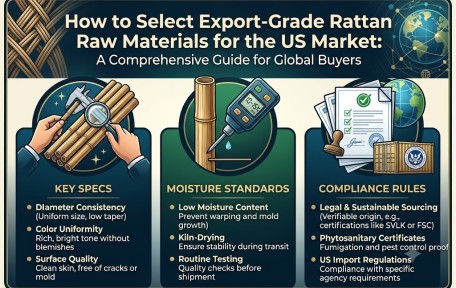
We do not rely on open-air sun drying, which creates uneven core moisture. Every batch of raw rattan, bamboo, and acacia wood undergoes computer-monitored kiln drying to achieve an optimal Equilibrium Moisture Content (EMC) of 8% to 12%. This precise threshold prevents subsequent swelling in humid climates and shrinkage in heated indoor settings.
Structural Reinforcement & Hybrid Weaving
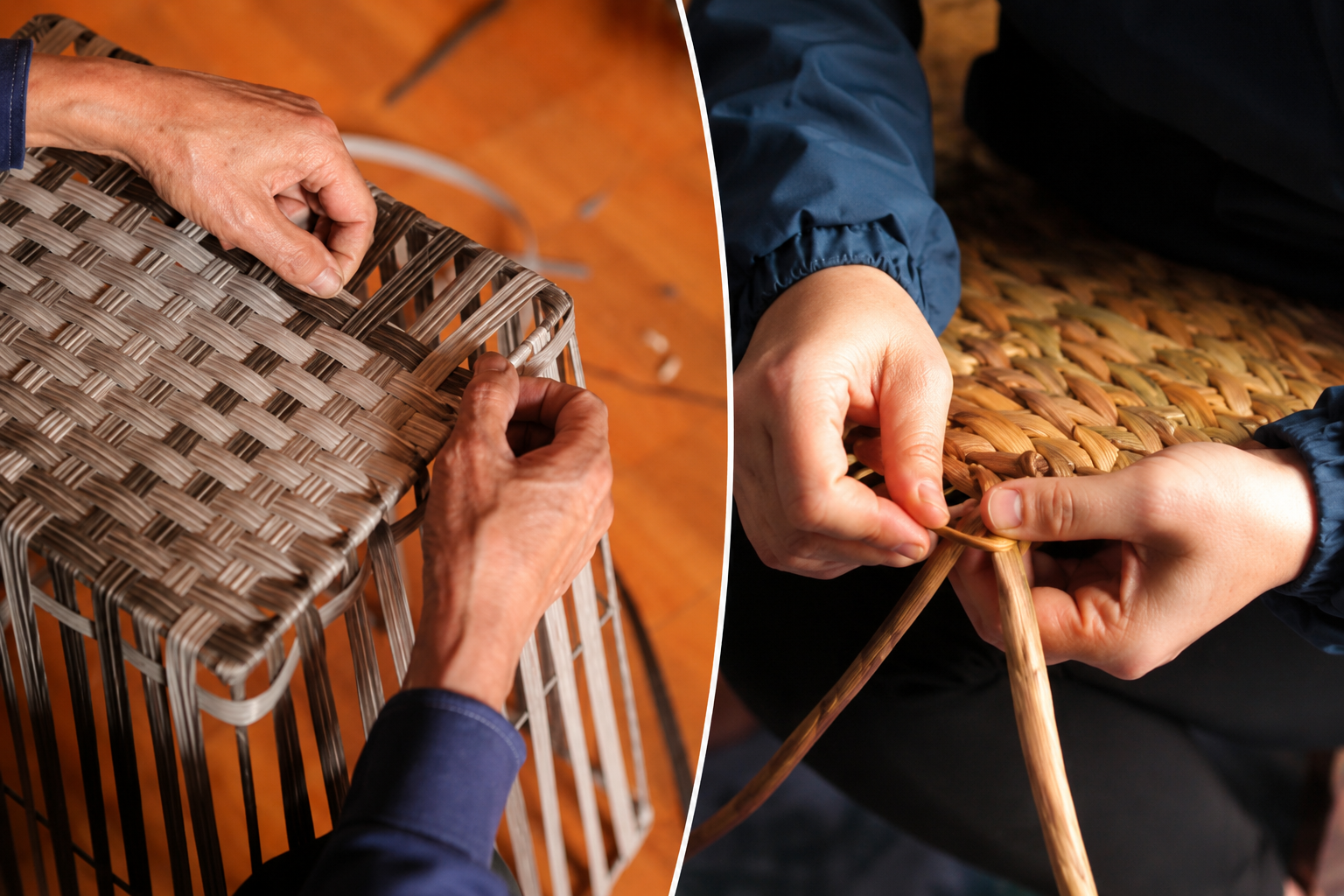
To resist thermal tension, Phu Minh incorporates reinforced acacia and metal skeleton frames treated with climate-stable primers. For high-stress applications, we integrate durable PP/PE synthetic resins or cotton/polyester ropes alongside natural water hyacinth and seagrass, granting the product elastic memory that withstands thermal fluctuations without losing its organic charm.
Advanced Protective Eco-Coatings
Every completed woven basket and storage unit receives non-toxic, eco-friendly sealant lacquers. These water-resistant topcoats seal microscopic plant pores, drastically slowing down moisture exchange and shielding the product against rapid environmental shocks during oceanic transit and retail display.
PROTECT YOUR MARGINS: PARTNER WITH PHU MINH FOR CLIMATE-TOUGHENED COLLECTIONS
Navigating global supply chain volatility requires a manufacturing partner who treats material science with the same discipline as aesthetic design. Phu Minh Co., Ltd. provides world-class buyers, catalog brands, and interior designers with fully certified, thermal-resilient home decor and storage solutions engineered for global performance.
Don't let seasonal climate shifts compromise your catalog's quality standard. Contact the Phu Minh OEM/ODM engineering team today to request custom material sample testing, review our comprehensive audit reports, and secure reliable, warp-free handwoven collections for your upcoming season.
FAQ SECTION:
1- Why do handwoven rattan and seagrass items warp when shipped across climate zones?
Natural plant fibers are hygroscopic, absorbing and releasing moisture based on ambient humidity and temperature. Rapid climate shifts cause uneven contraction between the weave and internal frame, leading to warping.
2- What moisture level prevents warping during cold winter transit?
Maintaining a strict core moisture content between 8% and 12% via controlled kiln-drying prevents excessive shrinking or swelling when items enter heated indoor environments.
3- How does Phu Minh Co., Ltd. ensure structural stability in storage furniture and hampers?
Phu Minh combines moisture-stabilized fibers with engineered acacia or metal frames, protected by specialized non-toxic sealants that slow down ambient moisture exchange under thermal shock.
4- Can synthetic resins or paper cords be combined with natural fibers to reduce warping?
Yes, hybrid weaving techniques—blending treated paper cord or PE resin with natural seagrass or rattan—provide enhanced dimensional elasticity while retaining an authentic handwoven look.
RELAVANT ARTICLES