How to Differentiate and Select Rattan, Bamboo, Seagrass, and Water Hyacinth: A Material Guide for Global Buyers

KEY TAKEAWAYS:
- Rattan features a solid core ideal for curved load-bearing furniture, whereas Bamboo offers hollow longitudinal strength for rigid structural framing.
- Seagrass possesses natural wax coatings and high moisture resistance, while Water Hyacinth offers a thick, soft texture suitable for indoor woven baskets.
- Selecting the right natural fiber based on tensile strength, flexibility, and humidity tolerance reduces product returns and enhances supply chain performance.
INTRODUCTION: NAVIGATING NATURAL FIBER SELECTION IN GLOBAL SOURCING
For international buyers and commercial interior designers, selecting the appropriate natural fiber is more than an aesthetic decision—it is a critical supply chain factor impacting product durability, shipping costs, and customer satisfaction. While Rattan, Bamboo, Seagrass, and Water Hyacinth are all eco-friendly materials driving today's sustainable home decor trends, their physical properties vary significantly. Understanding these structural differences enables purchasing teams to specify materials accurately for storage baskets, furniture, and decorative accessories.
PREREQUISITES: ESSENTIAL EVALUATION CRITERIA FOR B2B PURCHASING
Before finalizing product specifications with manufacturing partners, commercial buyers should evaluate natural fibers against four primary technical parameters:
- Tensile Strength & Structural Rigidity: The capacity to withstand mechanical load and strain without fracturing.
- Pliability & Fiber Length: The ease with which the fiber can be bent or woven into intricate patterns without cracking.
- Moisture Absorption & Environmental Stability: Resistance to ambient humidity, mold, and dimensional warping.
- Density & Weight Ratio: Implications for overall product weight and container freight optimization.
STEP 1: EVALUATE RIGID STRUCTURAL FIBERS – RATTAN VS. BAMBOO
Rattan (Calamoideae)
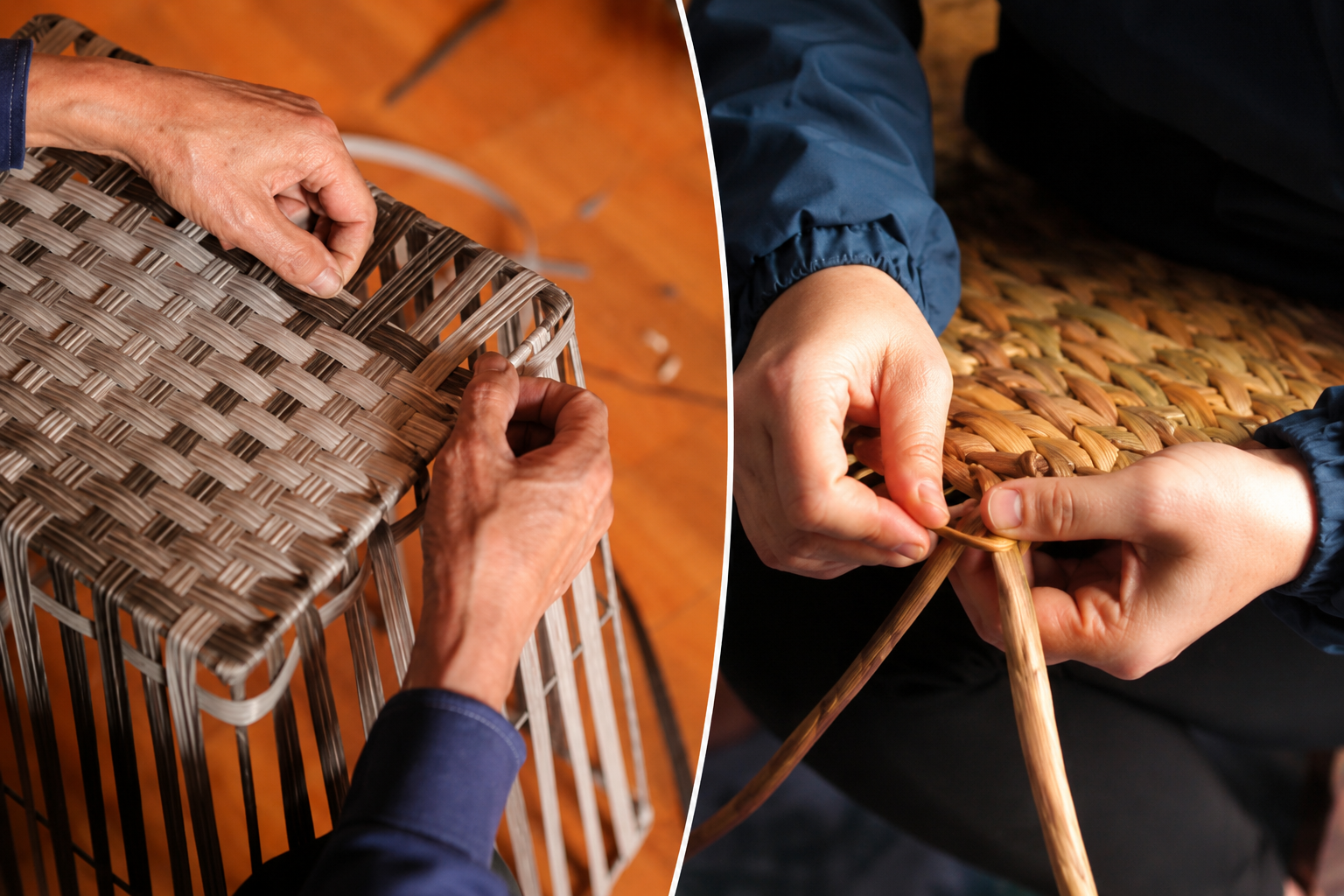
Unlike bamboo, rattan is a solid-core vine with high flexibility and exceptional tensile strength. Its continuous fibrous inner stem allows it to be steam-bent into complex organic shapes without breaking. When peeled, the outer skin provides a glossy, durable surface for weaving, while the inner core (reed) serves as robust structural framing for chairs, headboards, and heavy-duty storage hampers.
Bamboo (Bambusoideae)
Bamboo is a hollow, woody grass characterized by distinct nodal segments. It boasts a higher tensile strength than many soft steel alloys along its longitudinal grain, making it ultra-rigid and load-bearing. However, bamboo cannot be bent into tight continuous curves like rattan unless split into thin slats or treated with heat. It excels in straight-line structural furniture, shelving units, and rigid table frames.
STEP 2: ASSESS SOFT WOVEN FIBERS – SEAGRASS VS. WATER HYACINTH
Seagrass (Cymodoceaceae / Posidoniaceae)
Seagrass harvested from coastal brackish waters contains natural oils and a waxy surface layer, conferring inherent water resistance and smooth tactile characteristics. Its fine, tubular strands can be tightly twisted or braided into dense, durable weaves. Seagrass products exhibit low hygroscopicity, making them less prone to mold in humid transport conditions, ideal for high-traffic floor mats, laundry hampers, and sturdy storage bins.
Water Hyacinth (Eichhornia crassipes)
Water Hyacinth stems feature a porous, sponge-like internal cellular structure. This gives the dried fiber a distinctive thick, cushioned texture that feels soft and luxurious to the touch. Due to its porous core, Water Hyacinth requires rigorous kiln-drying processes to maintain moisture levels below 15% before export. When properly dried and sealed, it creates stunning, chunkier weave patterns suitable for indoor baskets, wall decor, and lightweight ottomans.
STEP 3: TEST MOISTURE TOLERANCE AND MECHANICAL PERFORMANCE
To ensure international compliance and prevent transit damage, buyers must match fiber performance to end-use environments:
- High Humidity & Outdoor Covered Use: Seagrass and treated Rattan perform best due to their dense outer cuticles and moisture-repellent qualities.
- Indoor Decorative & Storage Applications: Water Hyacinth offers superior aesthetic depth and softness, provided it is stored in dry climate-controlled settings.
- Heavy Load-Bearing Requirements: Bamboo and solid Rattan frame construction are mandatory for furniture items subject to repeated stress tests under ISO 9001:2015 quality frameworks.
STEP 4: MAP FIBER PROPERTIES TO TARGET PRODUCT CATEGORIES
Optimizing Material Selection for Retail Product Lines
At Phu Minh Co., Ltd, we work closely with global retail partners to match product designs with certified raw materials. Here is a quick reference guide for catalog development:
- Laundry Hampers & Storage Furniture: Rattan frames paired with woven Seagrass panels offer optimal structural integrity and humidity resistance.
- Home Decor & Wall Baskets: Water Hyacinth provides rich texture and warm golden tones for decorative wall hanging sets and light storage baskets.
- Foldable Organizers & Shelving: Bamboo structures combined with paper cords or flat Seagrass braids deliver lightweight strength and easy collapse mechanisms.
CONCLUSION: SECURING CERTIFIED SUSTAINABLE QUALITY WITH PHU MINH
Differentiating the physical properties of natural fibers allows global buyers to craft high-performing home decor collections while mitigating quality risks. At Phu Minh Co., Ltd, our fully audited facilities operating under BSCI, SMETA, SCAN, and WCA standards ensure every shipment of rattan, bamboo, seagrass, and water hyacinth products meets rigorous international quality control and moisture criteria. Partner with our engineering and design team today to turn natural fiber insights into commercial success.
FAQ SECTION:
1- Which natural fiber is most resistant to mold during ocean transit?
Seagrass is the most mold-resistant among the four due to its dense fiber structure and natural waxy coating. However, proper kiln drying down to 12-15% moisture content across all materials, combined with silica packets during container loading, ensures safe transit.
2- Can Water Hyacinth products be used outdoors?
Water Hyacinth is best suited for indoor dry environments. Because of its sponge-like porous core, outdoor exposure to rain or high humidity can lead to moisture absorption and mold unless treated with specialized protective clear coats.
3- What is the key structural difference between Rattan and Bamboo?
Rattan has a solid core that can be bent in any direction using heat, making it ideal for curved furniture shapes. Bamboo has a hollow core with vertical nodes, offering high linear strength for straight structural frames.
4- Does Phu Minh Co., Ltd provide BSCI and SMETA audited natural fiber products?
Yes, Phu Minh Co., Ltd operates under international social compliance and quality management standards, including BSCI, SMETA, SCAN, WCA, and ISO 9001:2015, ensuring ethical and reliable B2B supply chain execution.
RELAVANT ARTICLES